This post was initially made for the Kumite Discord server.
That's right, Nitroplus Blasterz. Or I guess more accurately: Nitroplus Blasterz: Heroines Infinite Duel. But let's just go with NPB or if you're feeling frisky: N+B. We love to encourage creativity here on the internet so go with whatever shorthand makes you comfortable, after all this is, inexplicably one of the most creatively-designed fighting games on the market. That's not a joke. Somehow this fighting game is genuinely unique among it's contemporary releases. But enough about that, let's get to the real question you're probably having right now.
What the fuck is Nitroplus Blasters?
Well first off, it's Blasterz with a Z you uncultured swine. More to the point, Nitroplus Blasterz is an all-star fighting game that brings in characters from a number of titles published by Nitroplus, who are best known for publishing visual novels with their most notable property at the time of writing being the Fate/Zero franchise in collaboration with Type Moon. Or, if you're a filthy degenerate like me, you had a different question upon first seeing this game.
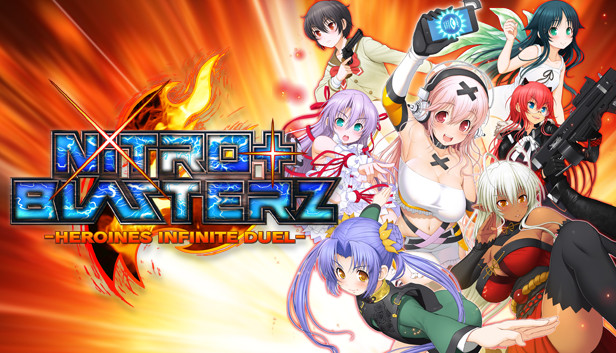 |
| N+B's banner art on Steam. Yes this game is on Steam. |
Wait is that Sonico?
Yes, yes it is. The other most notable property in the Nitroplus (n+) umbrella is the mascot of their annual music festivals Sonicomi, or Sonico. If you're familiar with her that actually gives you an okay idea as to what kind of content n+ is most known for. Namely a strange amalgamation of humor, romance, comedy, horror, and eroge. Okay so the horror part doesn't really apply to Sonico herself (unless you think about it long enough) but I'll get to the roster breakdown later. For now: yes this game features Sonico as both a playable fighter as well as an assist.
Mechanics
Assists
You might have noticed that I mentioned assists just there. That's because N+B has an assist system. When picking your character, you also select two assists that can be deployed during the fight. There are 20 of these assist characters, and the game will offer a recommendation of which ones generally work best alongside your selected fighter by putting a little star next to them. The effects of these assist characters can vary significantly, from Sonico's band throwing out random buffs that either fighter can pick up, to a robot girl from a game I've never played launching into the air and calling down an air strike. Generally, the greater impact an assist can have, the less you'll be able to use it. Both assists start a round locked behind a timer, and won't be available until a certain amount of time has passed from the start of the round, big, damage-dealing, combo-starting/extending assists will usually take longer to unlock than assists that just do a single hit, or act merely as an anti-air. Mixing and matching your assists with your selected character can open up a surprising amount of depth to the different combinations you can create, and therefore, a potentially limitless amount of custom combos you can pull off, especially when you're more familiar with the games other systems.
Buttons
Right but I've gotten ahead of myself haven't I? You can't do any of those things if you don't know what buttons to hit. Well, actually you probably can do some of those things by mashing all the buttons as fast as possible, but usually your opponent will be able to punish you if you do that. And not the fun kind of punishment that you might be thinking of if you clicked on this page because you saw Sonico. N+B is a 5-button fighter, meaning you have 5 different buttons that do different things. If that sounds like a lot, or you just want to continue the theme of putting a Plus into your notation, you can think of it as a 3+2 button fighter, as there are three primary attack buttons and two more specialized buttons. These buttons are A, B, C, D, and E. If you know you're ABC's you're already off to a good start!
A, B, C
So the first three buttons are pretty straightforward. They are Light (A), Medium (B), and Heavy (C) attack buttons. So yeah, nothing too crazy so far; the vast majority of special moves in the game are performed via a motion input (think a quarter circle forward) and then hitting one of these three buttons. For the most part, each button will correlate to a different version of the same attack. Usually the heavier forms of a move will just be a slower, more damaging version of the same attack you'd get by hitting A, but sometimes it will change the angle of attack, allowing you to hit higher or lower than the A-button version of the move. If that sounds a little overwhelming don't worry, you can figure it out pretty quickly by trial and error, and there is a whole training mode and all that stuff.
Beyond the basic attack aspects of these buttons, hitting B+C at the same time performs a grab. This is a universal command for all characters and it behaves pretty similarly to how most fighting game grabs do. Similarly, hitting B+C while being grabbed will break your opponent's grab. There's couple of scenarios in which you won't be able to break a grab. The first is if it's a counter grab, meaning the grab interrupted the startup of a different attack. The other involves a mechanic called Vanish, that I'll explain more on in a bit.
Finally, hitting A+B+C at the same time can also activate your Infinite Blast. If you've played any of the Guilty Gear games this will seem familiar. Infinite Blast can be performed once per round. It's effects will change slightly based on what you were doing when you activate it, but the general gist is that it creates an invulnerable burst around you, which can knock back an opponent, and then buffs your attack speed and damage, as well as steadily filling up both your health bar and your charge meter. I'll go into more detail with Infinite Blast in a bit once I've familiarized you with some of the other important details, but for now I'll just say that it acts as sort of a combination of Roman Cancelling and Bursts (from Guilty Gear) as well as Max Mode (from King of Fighters XIV).
The one last note I have about these three basic buttons is that they're the ones you use for supers. Every character will have a few unique supers that take up one level of meter. These will always be done by performing an input and then hitting A+B at once. On top of that, everyone has access to a 3-level super called a Lethal Blaze, which are always done with the input of two quarter circles forward and B+C at the same time. In numpad notation, this would read as 236236 B+C.
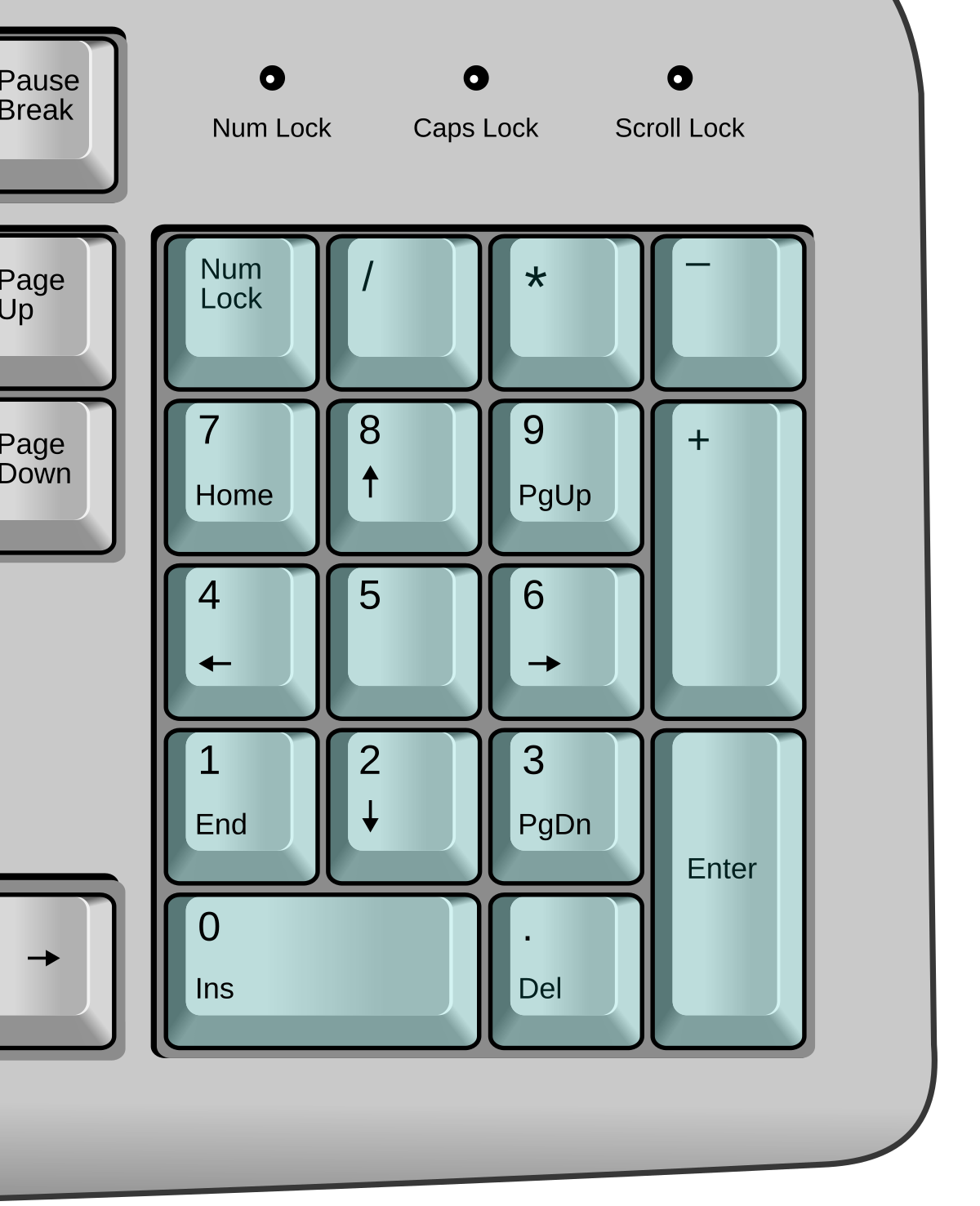 |
| Numpad notation refers to the numpad on a keyboard, where the arrows you can see on the numpad correlate to directional inputs on a joystick. So 2 would mean Down, 6 would mean Forward, 4 would mean Back, and 8 would mean Up, with the diagonals being referred to as 1, 3, 7, and 9 respectively. |
E
You may have noticed I skipped D, don't worry, I'll give that later. Wink. No, but actually D is used for a lot more things than E is and I'm going to try to collect all the most complex mechanics in one spot. So instead let's talk about E! As a trans girl I love E! If you don't know why I said that, don't worry about it. Instead, just know that E in N+B is basically this games equivalent of the Dust button from Guilty Gear, and much like Dust in those games...it's on E? Okay so maybe the lettering isn't a helpful way to remember this, but it's fine. E is a universally similar button across characters. It has a standing version, a crouching low version, and an air-based version. Standing, or Neutral E (5E, if you prefer) is a universal guard break attack. You can charge it and it's quite unsafe in general but unless the opponent is using that Vanish mechanic I alluded to, it will break guard and if they're not guarding it deals a hefty amount of damage and will often let you start a combo.
Crouching E (2E) is a universal sweep. This is just straight up the same thing that crouching dust does in Guilty Gear. Similarly, the two types of E attacks can help mix-up your rhythm during a pressure string, and hopefully catch an opponent off-guard. Jumping E is actually just another air attack. This attack is different between characters and really doesn't have many unique properties other than that it's usually (though not always) slower than the other air attacks but with a larger hitbox.
E can also be used for a sort of counter attack special. If you've played SFV you may find it similar to spending a bar of your V-Trigger to get out of blocking. In N+B these are called Counter Raids, and by spending one bar of meter, you can hit forward and E (6E) while blocking to launch into an invincible guard cancel attack. These are unique to each character, meaning some characters Counter Raids are a lot safer than others. If your opponent has read your intentions, they can bait out a Counter Raid, which can put some characters in a real pickle.
Okay so you know how I said E wasn't used for any more elaborate things? That was a lie. I deceived you. I am a master of manipulation and espionage. E is also used for a mechanic called Variable Rush, which used up two meters and essentially launches into a custom combo state. The move that initiates Variable Rush is invulnerable, and usually lets you fly across the screen, which is pretty baller. After hitting, hitting A, B, and C will allow for follow up attacks. During the follow up attacks, you can't be hurt by an opponent's assists, which can make it very helpful against utility or zoning assists. Your opponent can still hit you in this state though, so don't just drop your combo because then you'll have spent two meters to get hit by an anime girl. Which isn't as fun as it may sound. That really is the most complicated use of the E button though, so it's still a lot simpler than The D, which as I said, comes later.
D
Okay, now is later enough. D is really important button in N+B because it's used for a number of different techniques that server different purposes. Unlike the other four buttons, which are almost exclusively used for offense, D stands for Defense. And uh, Assist. And Vanish. And Evade. And hmm...Maybe D doesn't stand for anything. Regardless, this is basically the button upon which the games most unique functions are performed. So instead of going into full detail on every single one of these I'm gonna just list the most straightforward ones here, and then cover the more involved concepts as their own sections in a bit.
So, apart from all the wacky stuff, D is used for Vanishing Guard and Evasive Action. Evasive actions are essentially just a sort of Dodge. Oh maybe D stands for Dodge? We'll workshop it. Hitting Forward D (6D) rolls you towards your opponent, Down and D (2D) usually performs a little hop in place, and jumping D (j.D) will usually do a sort of moving dodge in the air based on the direction you're moving in. If you've ever dodge in Smash Bros. that's probably the closest analogue. These Evasive Actions are immune to projectiles for at least part of their animation, though the exact amount of distance covered and time spent in an invulnerable state vary from character to character. It would be bad, for instance, if a grappler had the means to just cross the screen while being immune to any zoning options.
 |
| O-oh, or not, my apologies sir... |
Evasive action can also be used to cancel out of a throw attempt if you whiff a grab. Grabs in N+B are generally harder to pull on than in a lot of other games, as they have a long-ish whiff recovery and a large window in which to break the throw. As such things like Evasive Action, Partner Blitzes, and Variable Rush can be used to cancel a throw attempt in order to balance things out.
Partner Blitzes are the most aggressive use of the D button. By hitting A+D or B+D you can call in an assist. As noted, you can cancel into Partner Blitzes from a fair number of animations, which can allow you use them as a get-out-of-punishment-free card if you whiffed something dangerous, but also means you can accidentally drop your own combo by cancelling an attack into a Partner Blitz at the wrong moment. You can also cancel a Partner Blitz with another Partner Blitz to get both your assists in play at the same time. This can be helpful for a few different things, most obviously the ability to just take up most of the screen with attacks, and force your opponent to be on the defensive, letting you go into your set-play if you have any. Another reason you might do this is just because you like Faust in Guilty Gear, or play Smash with the items on. Which is all to say, you love chaos.
 |
| DO YA HAVE IT? |
 |
| Haha numbers! |
Finally, each type of attack in the game in generally categorized into four levels based on their speed and damage. The general rule of thumb when performing a combo is that any attack can cancel into a higher level attack, meaning you could cancel a standing light attack (Level 1) into a crouching B attack (Level 2) into a C attack (Level 3) and then into a special (Level 4). These levels are also defined by their recovery time after the attack, as well as how long of a blockstun they put an opponent in. Please note that you cannot cancel from a Level 2 into a Level 1, or descend levels if you're hoping to cancel, but if you manage to finagle things just so, you hit a Level 1 attack after a higher level one if your opponent isn't able to defend themselves adequately, thereby letting you reset your combo. I'm going to post the frame values for these Levels, as sourced from the Mizuumi Wiki, but do note there are a couple of exceptions, as some moves launch or wall-bounce, which would alter the whole nature of what kind of cancels you'd be trying to pull off.
 |
| The easiest way to think of this is that a combo just slowly escalates from lighter to heavier moves. |
 |
| Choose your fighter! Or your uh, Infinite Heroine? |
 |
| Choose your homies wisely... |


Listen I'll be real with y'all I do not like lolis and I'm unsettled by people who are really into lolis. Ouka used to be the mascot for nitro+ before Sonico rose to fame, and as such she is now livid at all these other girls stealing her limelight. She is out for BLOOD and she has a PANDA and a giant cross with rocket boosters attached to it. Which, honestly? Valid. She also shoots rockets, a shield she can create, a giant ball-on chain thing that she swings around, and the ability to fly around thanks to aforementioned rocket boosters. She's kind of like a mech, although there are other girls that are more like a mecha, and assists that use literal mechs, so maybe that's the wrong comparison. She's actually the largest character in the game thanks to her giant cross mech thing she's got going on. Since she flies around, she can do a lot of aerial combos, and her best assists will usually be ones that help initiate this by launching opponents or keeping a comfortable distance when grounded.

Boi-oi-oi-oing! Anna is from a VN called Gekkou no Carnevale, and she's like an automata puppet thing that works for a circus? Or uh, something? Anyway, she's primarily a zoner, as her C moves generally involve just shooting a ton of little spikes at her opponent, a lot of her specials also focus on this. She also has a hover dash, so if you like playing I-no in Guilty Gear, well this girl also does that but has projectiles, lots and lots of them. She's not useless in close range either, with competent high-low mixups and a special counter move that creates huge separation between her and her opponent allowing her to return to her funny zoning techniques. As such her best assists will usually either help her create space, help her engage the aforementioned high-low mix up, or help string together moves in the air.

From what I understand, Ethica appeared in this game before her own game actually debuted. As for her own game, it's called Tokyo Necro and Ethica likes to research on corpses. She's also gay, so good for her. Beyond that, she's this game's resident grappler. All her specials are either grapples or moves that combo directly into grapples. Her supers actually all chain together, with her Lethal Blaze only costing one bar of meter with the caveat that it can only performed after hitting both of her other supers as one long chain. As such, using a super with anything less than 3 full meters to work isn't gonna be worth it for her. Well, she does also have a different, one bar super command grab that you can use but like, you're not gonna impress the chicks if you aren't chaining three super grabs right? Anyway she wants to close gaps, so moves that force an opponent to stay blocking, or knock them towards her are good, as are assists that generate meter for her.

Mora is a dhampir with a hammer. She's from uh Vampirdzhija Vjedogonia, which I guess is a vampire thing. Did I mention she has a hammer, because she has a hammer. The hammer means she can deal a lot of damage very fast, but also because it's a really big hammer she can't like, throw it or anything, she just hits you with it has moves that help her get into hammering position. These moves include both high-low mixups and cross-ups and she do a lot of damage after just one slipup by her opponent. She's somehow an even more extreme specialization than Ethica, as Mora really doesn't have a lot she can do from range, and her best assists will focus on allowing her to get in on her opponent, or if you're feeling creative, offering some form of long-range attack to balance her moveset.

Saya is from Saya no Uta (Saya's Song is what I think that translates to?). Spoilers for that game here: she's a meat...thing? She utilizes set play by way of placing little meat-mines on the field that can control a large amount of the stage if she gets time to set it all up. She also has a stance in which she can throw out a meat tendril to either grab an opponent in front of her from mid-range OR an anti-air grab. Beyond that she has some very large buttons that can do some nasty stuff once she puts you in the meat-mine-hell-zone. Her assists similar would emphasize either getting her away from her opponent or keeping them in a ceaseless, meat-based juggle.

Gun girl! Gun girl! We got ourselves a gun girl. I know one of my friends was upset that the gun girl they wanted in this game wasn't in it, instead we have Ein. Ein is from PHANTOM OF INFERNO and she's an assassin and in case you couldn't tell from my yelling, she has a gun. She's focused on speed, with high speed normals and projectiles, with the obvious weakness being health. It's genuinely possible for Ein to die from one really good combo by the opponent, and as such you need to be careful with spending your defensive resources. Assists that can help her escape a dangerous spot, reinitiate a combo, or just buff her health can all be useful for Ein. I should also note that her Lethal Blaze is rad as a hell, as she leaps off the screen and you manually aim a sniper rifle at your opponent and try to hit them.


Ruili is from Kikokugai: The Cyber Slayer. I don't know what that means. Apparently she is a gynoid that involves fusing someone's soul into a cybernetic uh, thing? She has a brother in her mind or something, so if you are a fan of Lejos and Selka, maybe this is good? Anyway, she is the Kenpo practitioner and fights along the lines of Jam, Xiangfei, and just any fighting game franchise's Chinese character. Similarly she's a close range monster with a ton of frame traps and moves to close gaps. She has no projectiles so that's obviously one of the things you may want to address with assists. She has a move that allows her to pass through a projectile, which helps her against characters like Saya. She also has a lot of health, to help her if she gets trapped in zoning hell. Still, assists that put her closer to her opponents help her out a lot.

Okay so you know how I mentioned that other girls were more of a mech than Ouka? I meant Muramasa who is a Demon Spider Mech Weapon Thing from Full Metal Daemon Muramasa. However, her moveset focuses more on the spider part, as she has a number of web-based attacks that allow her to fly around like Spiderman, pull opponents towards her, and trap opponents with a trap set on the ground. She also has a rushdown rekka move and a super in which she turns into a mechanical spider and heals herself. She hits hard and moves around like crazy with the ability to be effective at both close and long range. Her biggest missing trait is that she has no reversal moves without spending meter, as such maybe you can guess what kind of an assist would be helpful for her. She's also not a very straightforward character and as such can take a bit of work to learn. The benefit is that your opponent may have issues if they aren't familiar with her. If you played Hazama in Blazeblue that probably helps give you some idea of what you can do with her kit as it definitely overlaps with his.


Ignis is from Jingai Makyou which I don't know much about. She's I guess some sort of mystical protector of earth from ancient times. So you know, good for her! She's a tricky fighter who can lay traps on the stage from range (including a super that lays a trap for a big exciting cut-in if they step on it. While her most elaborate and intriguing gameplay is from range, she has a command grab and can still function close-up. Like Muramasa, she lacks a meterless reversal move with invincibility, so you once again want to use assists to compensate for that unless you just really want to burn a lot of meter on reversal supers. She also has a move where she throws a lighter that then explodes, which is just cool.


The other guest character is Heart Aino from Arcana Hearts, although you're more likely to recognize her from Blazblue Cross Tag. She's actually the most prototypical shoto character in the game, a kit very similar to Ryu from Streets. She's a little more elaborate with the different forms her attacks can take based on what buttons you hit. As such, she's even easier to pick up than Saber, especially since her moveset isn't very different in this game from any of her other appearances. Still, despite her well-rounded kit, she's meant to be a rushdown character, with her projectiles having a long recovery and being equipped with quite a few moves to close the distance between her and her opponent. Assists that close gaps or help her launch opponents for aerial combos are probably her best bet, though she's fairly versatile and can probably make use of most assists.


No comments:
Post a Comment